My (college-level) field natural history students have an option to submit 100 iNaturalist observations for their final semester project (50 species, minimum). Previously, I’ve asked them not to use Seek for this, and they have to list the identifying features to show how they made the identification. This year, because of the integration between Seek and iNaturalist, photos that are uploaded get an automatic species-level identification. I’m aware that it’s possible to “discard” the suggestion, but what I’m wondering is, can you disable the automatic AI suggestions? If not, I’d love to suggest this as a feature.
I worry that this really undermines the utility of iNaturalist for educational purposes. The students are really frustrated about it, also, and were pretty demoralized. They worry the app is replacing people, they’re worried that they’re cheating, and also that it’s too easy for some students to game the system while others put in the work of a final project.
I can see your issue, and I’m proud of your students for wanting to have a valid ID experience. As a temporary workaround, you could require that they use the “iNaturalist classic” version of the mobile app, which is still available (for iPhone, but I don’t know if that’s true for Android). That makes the AI (“Computer vision”) suggestion optional. You can point out to them that the ID is tagged with a symbol if the AI is used, so you can tell if they used it (although I guess they could get the AI suggestion and then type it in themselves). Or, you could ask them to say why they chose their AI choice as opposed to some other on the AI list. What kinds of resources were you expecting them to use if the AI isn’t available? Seems like nobody is lugging around field guides any more.
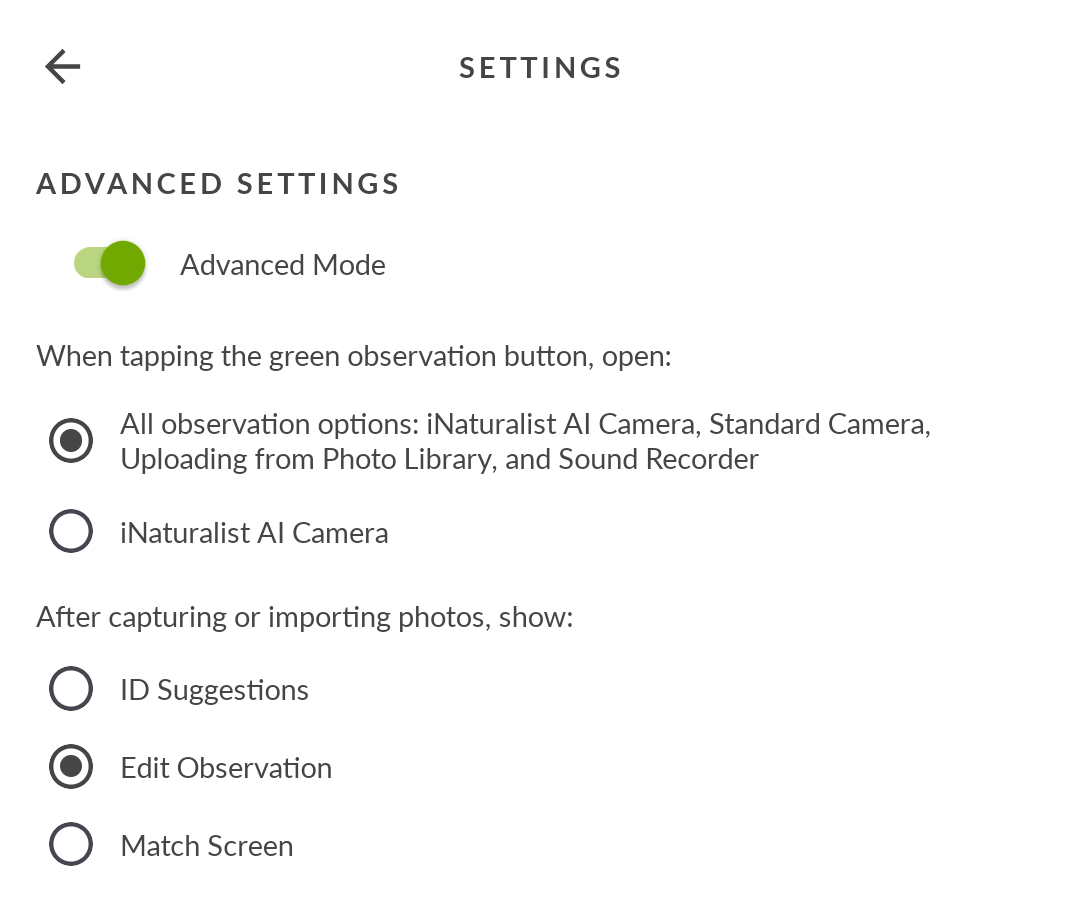
On iOS, change it to “edit observation” under “after capturing or importing photos” (advanced mode):
On Android and iOS Classic, uncheck “suggest species”:
(The topic is tagged iOS classic though so I’m not quite sure if you’re referring to Seek or the iNaturalist apps.)
Another idea: Allow them to use the AI for identifying, but when they get done, the project requires them to analyze what they found in some way. How many phyla, classes, and families are represented in their collection? If they collected in two distinct habitats, how did the flora and fauna differ between them? Simple questions but that make them look back at what they posted.
I thought of this setting, @bouteloua, but doesn’t the first choice “All observation options” still leave the AI camera as one way of taking the photo? Just not the only way.
Sure - also anyone could use the AI camera or suggestions and then delete the ID and manually enter it so that the little computer vision icon doesn’t appear on the ID.
Perhaps you could ask students to target morphologically similar species? As you get into taxa that are smaller, uncommon, visually/morphologically similar, or just not as easily opportunistically sampled (e.g., fish and arthropods), then the computer vision (CV) model is not as effective at identifying observations to the species-level with high confidence scores. It is inevitable that some students will use AI (in any class, really). In this case, the students can technically still use the CV model to “cheat,” but it may not be accurate without using their human identification skills (such as by looking at morphologic characters and using a taxonomic key). This could be a useful approach to show students both the benefits and limitations of the CV model - it can help students get into the right “ballpark” (kingdom, family, etc), without actually giving them the species-level ID.
Android only had the classic version available in Google Play, installing the new Android version you have to get it from Github.
It seems like it would be extremely easy for reasonably intelligent college students to bypass any sort of setting that restricted AI suggestions (how could you tell if they change their settings as requested and refrain from changing them back? Or if they looked at the suggestions through the browser or an alternate account before reaching their ID as bouteloua mentioned?). Depending on the integrity of the class involved, trying to keep them from looking at the suggestions could simply disadvantage honest students.
Another approach would be to treat the AI as a hypothesis generator rather than an identifier, as this is exactly how it should be used. Require that they critique the suggestions and grade them on their reasoning and their process. “AI said it’s this” would fail, “AI gave me these suggestions and the thing I saw looked more like the picture for this species than the others” would get a relatively low grade, while an answer that systematically eliminates possibilities and then does research beyond the CV suggestions (looking for taxonomic keys and publications) would get a good grade.
kmtorres also has great suggestions. The CV model does very poorly with most mushrooms and insects. There are a lot of cryptic and semi-cryptic species that require DNA sequencing, microscopy, or high-quality close-ups of very specific features to identify. The AI doesn’t know this, so it just suggests species that look similar to your photo that other people claim to have observed (often incorrectly). In cases like this, the proper identification would be at a higher taxonomic level like section, genus, or even family, because it’s simply not possible to know the species from a photo.
You could require they observe and identify some of these more difficult taxa. Students who simply pick the suggestion that looks most like theirs will incorrectly arrive at species-level IDs that can’t be supported, while those who engage their brain will arrive at higher taxonomic levels and be able to explain why it’s not possible to identify the species. That would be an incredible amount of work to grade if they are doing a hundred observations each however (and also a lot of work for them). One idea is to assign specific “example” observations, pictures and descriptions that they need to independently identify without uploading to the site. This way you could know the proper answers ahead of time and grading would be easier. I’m sure users here would be happy to provide some examples that could be used for this. Or just lower the required number and put heavy emphasis on quality over quantity.
And finally, it’s nice to teach about the limitations of the technology and why independent critical thinking is as important as ever. The AI has absolutely no common sense. I have literally seen it suggest IDs of specific species of morel mushrooms for a piece of wood laying on grass, a peanut shell, and an old avocado in the dirt. People blindly accepted these suggestions without ever stopping to think about whether they made sense. Knowing about this will hopefully make students less likely to misuse it and show them the value of their skills and knowledge in an age of AI.
I was going to suggest something like this – while I applaud the students for wanting to make IDs themselves without the AI, it seems like this could be a teaching opportunity about how to use AI and its strengths and weaknesses.
Perhaps instead of trying to find ways to remove it (which students would no doubt be able to circumvent if so inclined), it would make sense to lean in to the AI and ask them to critically engage with the suggestions, maybe by writing up some notes about their own thought processes and research and how it compares with what the AI suggests.
I regularly complain here in the forum about iNat’s CV model because for the taxa I am interested in it is extremely unreliable and too many users trust the suggestions uncritically. At the same time, I think it is an incredibly valuable tool, when used as a starting point for research instead of the conclusion. There have been plenty of times where I have seen something and I have no idea what it is and I wouldn’t be able to classify it beyond something very very broad like “arthropods”. Often the CV suggestions will give me some ideas about where to look, to help narrow the search. This isn’t cheating or taking shortcuts as long as the CV is supplementing one’s own thought processes instead of replacing them.
@glacialdrift – Great to see a teacher putting serious thought into how to use iNaturalist! Too many seem to just send students out to photo landscaping around the school without doing any follow-up. Thanks! (We see some depressing products of school projects here.)
However, I disagree without your idea to disable iNaturalist’d CV suggestions for them. It seems to me that creating such a clearly artificial impediment to student identifying is almost like asking them to cheat. Asking them to evaluate the CV suggestion looks like a more serious request, a potentially realistic challenge, something worth their effort even if they choose to find a workaround.
Could that form the basis for a renewed Feature Request? Implement a toggle for the CV a.k.a. “automated AI identification”, according to modalities to be discussed (in which parts of the site and apps? with or without keeping autocompletion?).
I am pretty sure I have seen one such feature request, although it was more about low-bandwidth conditions than educational use.
I train them to use field guides and dichotomous keys, and I’ve got copies for the class to share and check out for independent work. They also have to buy a couple of general guides in lieu of a textbook, so they own a couple as well. The classic version is a good suggestion but I can’t figure out if it’s feasible for the Android users.
Thanks – that was a misclick on my part, as my students aren’t using Classic (most are using the current app and I’ve asked them not to use Seek in the past). I’ll share these settings with them.
I would much, much rather see AI be an “opt in” rather than an “opt out” feature.
I already have them submit an essay where they analyze their results. This is a 40-hour project that has to showcase multiple skills, including identification, in part because they are natural sciences students and many of them will go on to jobs where they are expected to key things out in extensive detail and where AI tools may not even work because of wifi reception (rural New England). If I can’t disable AI I’ll just eliminate this as a final project option, which would be a bummer.
I’m not particularly interested in teaching students how to use AI effectively. They’re getting plenty of that elsewhere. What they aren’t learning are professional skills like using dichotomous keys, or critical thinking, being confident in their answers, etc. There’s a growing body of research that suggests AI is helpful ONLY if you already have the skills and knowledge to engage with it critically, and undergrads need to gain those skills first. Starting from a position of using AI for everything means you never develop the critical thinking, communication, and analysis tools that make using AI potentially useful. My approach to this class and to pedagogy in general is basically anti-AI, and the energy demands and reliance on stolen work makes this an ethical non-starter for me anyway.
I don’t understand how not having a suggested identification automatically is an artificial impediment when the goal of the exercise is to use the skills they’ve learned in identification and the use of dichotomous keys to make an informed taxon assignment. My students managed to complete this assignment every year for a decade without CV suggestions just fine.
You’re right. I was just having a frustrating thought about students who put more energy into working around a task than doing it. In general, making students do their actual identifications is good.
You’ve been introducing students to iNaturalist for a decade with this assignment? Good for you, and I hope it has resulted in many long-term users. I hope you get this worked out.