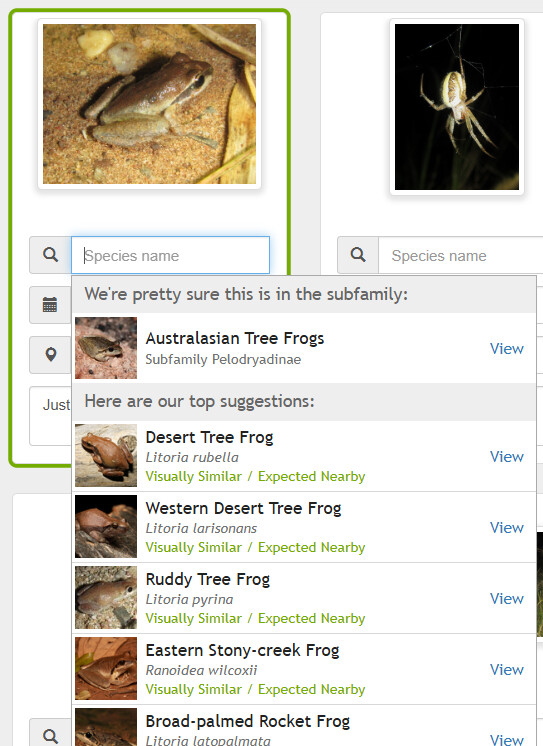
I’ve just come across some strange behaviour from the CV suggestions after a taxon split. Recently, the widespread and common frog Litoria rubella was split up into three separate species - L. rubella, L. pyrina, and L. larisonans. As expected, L. rubella has been included in the CV and geomodel training for quite a while so it obviously comes up as an option when presented with a similar frog. After this taxon split, the CV now suggests all three species as options when uploading:
This doesn’t seem like it should happen - neither L. pyrina nor L. larisonans have been assessed by the CV, even if it has used images of them for training. It’s not ideal to have only L. rubella show up in the CV until the next training round happens so I can understand the reasoning behind why all three may show up, so perhaps this part is not a bug.
This next bit is surely a bug though - when I go to the taxon page for, for example, L. larisonans, under the ‘About’ tab it claims L. larisonansis included in the CV and geomodel. However, clicking on the link that usually takes you to the geomodel leads to a 404:
This current behaviour from both sections seems odd and not correct. I’m not entirely certain what a good solution would be though. The best option that I can suggest is that if the CV has been trained on a taxon that has since been split, instead of showing that taxon (and/or the other things it has been split into), perhaps just show the highest taxon that includes all of the output species? Keen to hear what others have to say though.
(and yes, I’m aware that my frog photo is none of those three species)
Urtica dioica (European stinging nettle) and Urtica gracilis (American nettle) is another recent split which is acting weird too - the American taxa will be readily suggested in Europe as “expected nearby” despite not being “Expected nearby” in the geomodel. I cannot find any literature that suggests it has been found in Europe.
The next model release, 2.23, I don’t think will be substantially different from 2.22. I expect it to be much closer to 2.22 than 2.22 was to 2.21 due to its new training approach. We did say in the 2.22 release blog post that “we’ll continue to refine how the geo model supports the computer vision system”. If we expect there to be more substantial geomodel changes in future releases, we’ll likely mention that in the release blog post. - pleary
this seems to be standard now — similar things have happened in other taxa (e.g. the split of the Erysiphe cruciferarum complex). all I would add is that this happens even when the output taxa wouldn’t normally be included in the computer vision suggestion list except under special circumstances, such as those of the rank of section, complex, etc.