I have been finding SO much Queen Anne’s Lace and am really curious to eat some. Wondering if there’s some good tips for ID-ing it because I know it looks somewhat similar to some hemlocks. Thanks!
If the plant is blooming, the central dark purple flower is a characteristic that I think only occurs on Queen Anne’s lace. One word of caution: I’ve weeded so much of this out of my yard that I’ve developed a contact allergy to its leaves by now. Based on my experience with it, I strongly recommend gloves/long sleeves for pulling it.
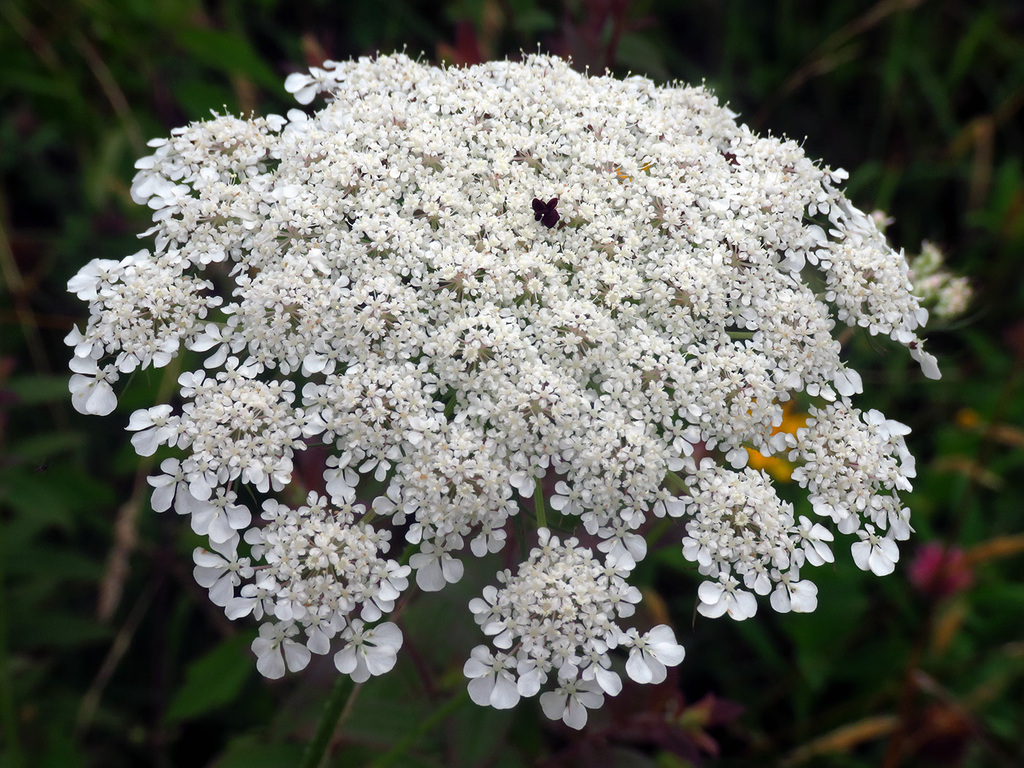
It should be noted that the dark floret is not always present on Daucus carota. Some dependable characteristics include the divided bracts subtending the flower heads and the hairy stems.
The flower isn’t present in the stage when you eat it, since the edible part is the root, and the root is all shrunken and shriveled in the summer when the plant is blooming. I identify them by their hairy leaves (poison hemlock is hairless and has a thick bloom and purple spots on its stem) and strong carroty smell.
Hairy stem, lack of purple spotting on the stem, + they have bracts under the umbels that some of their poisonous cousins lack.
That said, I’m so iffy on foraging any wild umbellifers for anyone that isn’t a very experienced forager- the consequences of a mistake are potentially fatal, and if you do get the right plant, it’s still just a carrot.
Second @lothlin’s point. I’ve grown it from seed, and when I finally dug it up, the root was very small and disappointing. The upper greens were a bit more substantial, but the texture’s a little rough and flavor can be a little grassy.
Carrot greens are underrated – a nice addition to salads, pesto, quiche, etc. (though I use planted rather than foraged carrots for this purpose).
I would expect the root to be rather disappointing if one is accustomed to domesticated carrots. The roots of wild carrots are small and rather tough and fibrous, often even in young plants. My impression is that foragers are generally eating the greens, flowers, or seeds rather than the roots.
Yeah, but I find them a little too strong. All a matter of preference, though.
I thought the root was poorest edible part in Wild Carrots, hence the contrast with Domesticated Carrots.
I thought for this reason roots are avoided for the Tender Shoots, Flower battered in butter/oil or the seeds saved as a seasoning. Or are there wild populations with good tasting roots much like the Domesticated Carrot?
oh I see I’m not the only one who views all other edible parts of the wild carrot as superior to the roots of wild carrots.
However, this begs a bigger question! If Carrots Greens, Flowers & Seeds are also edible, why hasn’t Carrot been domesticated for these edibel traits as well? It seems we focused on the root edibility & ignored all other edible traits during domestication.
Is it possible that the domestic carrots can also be used in the same ways as the wild carrot or does the domestic carrot suck at having good tasting greens, flowers & seeds too?
oooh! and another question, does the flavor of the root translate into the flavor of the shoot? Since it’s the same stored up energy rising every spring, maybe the same flavor too?
I’m asking from a plant breeding point of view, since I want to taste every carrot & get seeds from the good tasting ones (But eating the carrot root means the individual plant that tasted good dies in the process & thus doesn’t make seeds).
Just think about how convenient it would be to just select shoot flavor & that selection pressure would translate into good tasting carrot roots too!
I kinda like the roots, and in winter I don’t really get fresh carrots. The stalks are good, but just too strong and carroty for me.
ooh! Are they good because you aren’t comparing them to domesticated carrots or are they better than domesticated carrots in some ways?
Gardeners who save seeds tell me to not let Queen Anne’s Lace pollute the genes of their carrot landrace. It worsens them somehow, but is this something I should be concerned with?
If Queen Anne’s Lace has very good tasting roots than it’s a Win & not a Loss, if you get what I’m saying.
There are generally trade-offs. If a plant is putting its energy into root development, harvesting the greens is going to reduce the amount of photosynthesis the plant can carry out and therefore also root growth. For humans, root vegetables tend to have certain advantages over leafy ones – they can be stored for long periods of time and thus are available during times of year when most plants are not growing. (There are exceptions – e.g. cabbages – but these start out with a very different leaf type than carrots that lend themselves better to enduring over time.)
But I really think there are other venues that would be better suited to your interest in plant breeding, and you would probably get more engagement and answers to your questions in, say, a forum for gardeners interested in alternative crops or improving wild plants for better yields, or even foraging communities. Many of your questions are outside the interests of most iNatters and you also seem to take a rather different approach to nature than most of us here (why not admire the incredible diversity of life that nature has produced, without reducing it to its usefulness for humans or trying to “improve” it and “make it better”?)
They’re pretty good in my opinion, and I eat them happily, but some can be pretty tough to chew and I do prefer domestic carrots (The crunch - I love it). But in winter, good, fresh carrots can be hard to come by for me, so if the ground thaws a little, I go out and eat the wild ones. I don’t think the wild/domestic carrot hybrids would taste bad enough that you should be worried, especially since garden soil generally has fewer rocks and stuff that can impact the overall tastiness of the root.
I once found a wild carrot pure, rich, rockless garden soil, and it looked more like a tentacle monster than a carrot. It was delicious.
That’s what I was thinking. As the great Sam Thayer once wrote, “You can enjoy the bounty of God’s garden, so why toil in your own?“ - NOT a direct quote, I just wrote something like that from memory.
Wild carrots are tougher because they are adapted to not being tilled. The tender roots of domesticated carrots, desirable for culinary purposes, would be too vulnerable for a wild plant.
Yes but I’m saving it’s seeds afterwards, as the goal is to taste “test test” the root without killing the plant, if you get what I’m saying.
Which forums would those be? I’m open to as many suggestions you got.
I agree! Diversity is for the win, which is why I want to cross up all the wild & domestic species together for maximum possible diversity, for the fun of seeing what new traits/diversity emerges (If they make the plant better, YAY!!!).
Oh… so you eat them raw for the crunch? Do the wild carrots after being cooked solve the texture issue? Do you also eat the greens & flowers?
Wow! If it was delicious, its seeds should be saved. Would be valuable for diversifying domesticated carrots. I hope to try a wild carrot eventually.
ooh! I like that altho if you really break it down, foraging & gardening are the same core activity just on opposite sides of the spectrum. I see no reason why not to garden the nature & forage the garden. So many wild species deserve to be tended to with care & so many Garden “weeds” are delicious & worthy of being foraged.
Doesn’t tilling eventualy make the soil tougher? Carrots wild or domestic need to be sown on the surface thus they both benefit from soil disturbance of some kind (Weather it’s slight digging or thorougho tilling)?
I’m hoping to grow carrots without tilling, hence why I want to select for rounder shapes in thicker clay soils as they preform better. Wild carrot genetics seem valuable for this purpose as well, especially if the tops add excellent flavor.
Google (or a search engine of your choice) is your friend. As it would be for so many of the questions you are asking. In your posts I see a lot of theorizing unbased on research or practical experience.
Again, why can you not take pleasure in nature without immediately asking how to alter it? Randomly crossing plants for your own entertainment will not necessarily benefit anyone other than the gardener. Diversity per se is not (ecologically speaking) always good in all contexts – it may be an indication of disturbance or other problems. Introducing novel species will by definition increase the diversity of the site in the short term, but this does not mean it is beneficial in the long term.
Tried it and keep trying, still haven’t found many forums. Foraging Forums are rare to almost non-existant, only appearing as a subtopic in the Inaturalist forums & occasionally a Gardening Forums.
ooh! Which parts are theory? I love to learn.
hmm… I really don’t know. I do appreciate Black Raspberries but I don’t want my love for plants to stop there if that makes sense, they have so much untapped potential to be better.
Do they? I don’t see it.