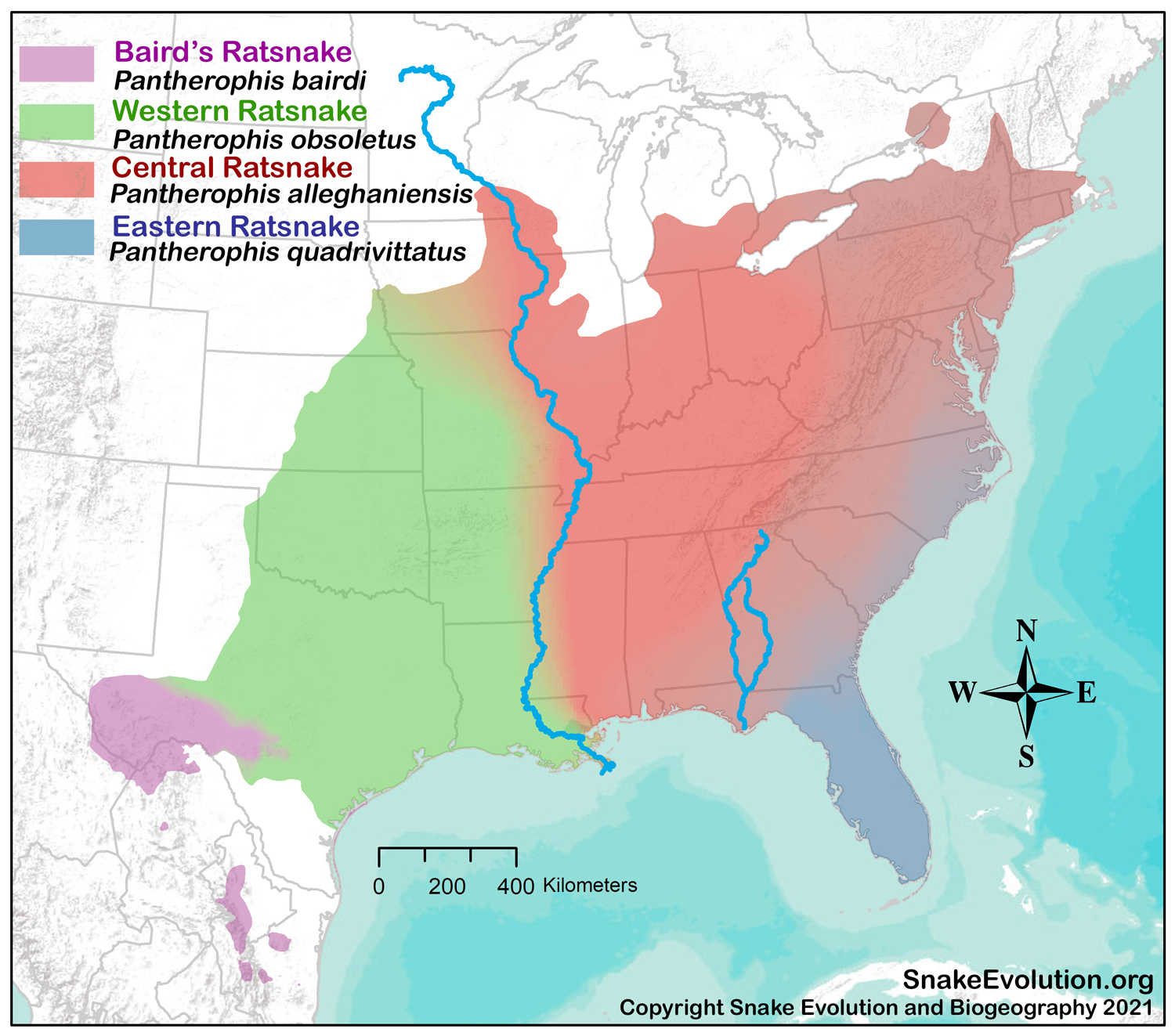
East of the Mississippi River, where one Pantherophis ends and another begins is one of the most contentious debates in herpetology. The taxonomy of the group has fluctuated and names have changed and/or swapped around very frequently as we learn more about the relationships of these taxa through molecular phylogenetics and phylogenomics.
These taxonomic issues stem from two major confounding problems: 1 - these snakes exhibit high phenotypic variation (think about the greens, yellows, blacks, greys, and combinations of each that can be seen in these snakes); and 2 - there has been extensive gene flow/admixture (“hybridization” isn’t exactly the correct term but also works) between what is currently considered P. spiloides (Gray/Black/Central) and P. alleghaniensis (Black/Yellow/Green/Eastern). Common names also can confuse things as depending on where you are they’ll be referred to different (or the same) common name. I’ll also add that changes in taxonomy in field guides tend to lag behind the scientific community by several years, and so there is a bit of reliance on outdated taxonomy. Most people following field guides (especially Peterson’s guide) will say that spiloides stops at the Appalachians, and alleghaniensis is east to the coast. Unfortunately, it’s not that simple.
Without going into the entire Rat Snake Taxonomy argument, the most recent research (Burbrink et al. 2021. Evolution) showed that spiloides/alleghaniensis have admixed extensively. What we would say is “true” alleghaniensis is only found in Florida and up a sliver of the SE Coastal Plain. “True” spiloides on the other hand is east of the Mississippi, and appears to have “come down” from the Appalachians into the southeastern United States. There, alleghaniensis and spiloides have admixed extensively, such that “true” Central rat snakes are East of the Mississippi through to the Appalachians, true Eastern Rat Snakes are along the Southeastern Coast, and everything else in between has genes from both species (essentially meaning there is no clear way to define them to species, despite what field guides may say).
Here is a relevant sampling map from the paper mentioned above; at the top, if it isn’t dark green or dark blue, it’s an admixed population with evidence of genes from both species. What is kind of interesting is this extensive gene flow doesn’t seem to be the case with other Pantherophis - bairdi/obsoletus (Baird’s and Western) and obsoletus/spiloides (Western and Central) don’t show the same levels of introgression (see the second and third maps in the link above).

To add to the confusion, the taxonomy of these taxa is still in flux - check out Hillis and Wuster, 2021 (Herp. Review - opens a PDF then scroll down a page) for a short summary there. This is in part because the name “alleghaniensis” is assigned to a holotype that is from the area of admixture, and likely represents a “hybrid” individual itself. (This goes against the rules of zoological nomenclature, which is a whole separate discussion).
So, the short answer to your question is: if you aren’t right on the coast, or from Mississippi east to the Appalachians, there is essentially no way to definitively say that the rat snake you see is either a “true” Central ratsnake (Gray; spiloides) or a “true” Eastern ratsnake (alleghaniensis). You’ll find some with characteristics of both, and it’s likely that they are the result of extensive gene flow over hundreds of thousands/millions of years, without a clearly defined assignment. In these cases I ID them as “Complex Pantherophis alleghaniensis” as you cannot tell the species apart in hand, regardless of color pattern or anything else. However, lots of users ID anything east of the Appalachians as alleghaniensis based on field guides, so it’s a bit of a mess on iNaturalist as to what observations are assigned where. Occasionally you’ll then get an argument in the comments; you might even get someone still arguing for the validity of Elaphe in North America or that everything should be obsoletus. It’s kind of a mess, and depends more on who ID’d your image than what species the snake actually represents.
The ratsnakes in the mountains of TN and Western NC are more towards the “true” Central (spiloides) end of the spectrum.
EDIT: Based on Hillis and Wuster 2021, the name alleghaniensis should be assigned to the central lineage, quadrivittatus to the eastern lineage, and spiloides sunk in synonymy. Here is a much clearer map image with those updates. This change is not reflected on iNaturalist at this time.